
Payroll Compliance India: PF, ESI & PT Guide for MSMEs
Last updated:
introduction
Payroll Compliance in India is no longer a “month end activity.” With the new Labour Codes, 50% wages rule, and EPF Wage limit raised from ₹15,000 to ₹25,000 effective 17 September 2026, even a small organization employing ten people can make errors in calculating salaries.
This book helps you understand PF, ESI, and Professional Tax calculations in simple language, with examples, enabling you to prepare payroll without errors, interest, and damages.
In this guide:
- The three deductions at a glance
- PF (EPF) rules and calculation
- ESI rules and calculation
- Professional Tax basics
- The 50% wage rule (what changed)
- A full payroll example
- Monthly compliance checklist
- FAQs
1. PF, ESI and Professional Tax: The Three Deductions at a Glance
PF (EPF) | ESI | Professional Tax | |
Who levies it | Central (EPFO) | Central (ESIC) | State government |
Employee share | 12% | 0.75% | Fixed slab amount |
Employer share | 12% (split into EPS + EPF) | 3.25% | Nil (employee's tax; employer deducts and deposits) |
Wage ceiling | ₹25,000 per month (from 17 Sep 2026) | ₹21,000 per month (₹25,000 for persons with disabilities) | Depends on state |
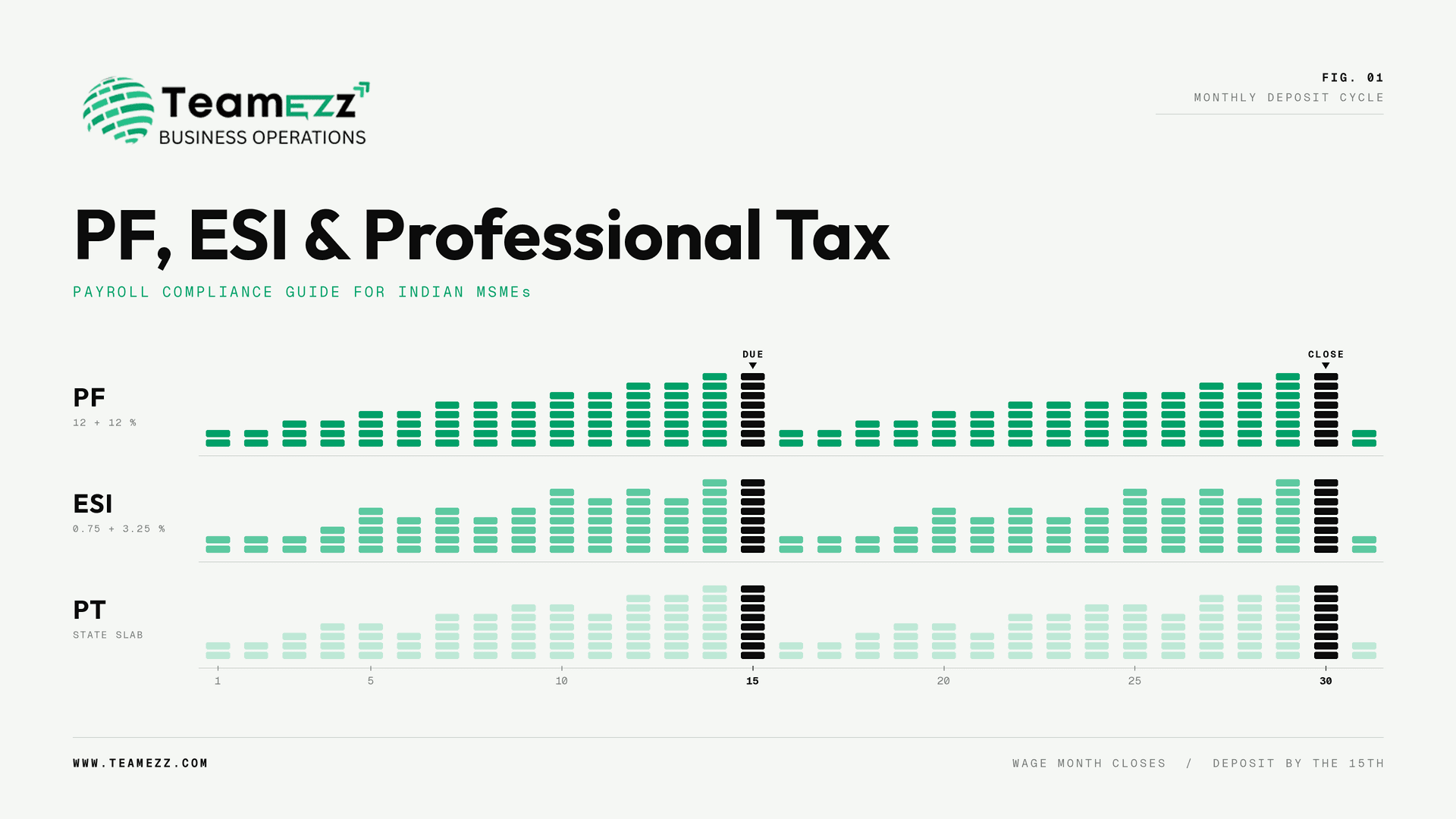
Monthly due date | 15th of next month | 15th of next month | Varies by state |
https://www.teamezz.com/online-payroll-service-small-business
2. PF (EPF): Rules and Calculation
The Employees' Provident Fund is a retirement savings scheme. Both employee and employer contribute 12% of PF wages (basic + dearness allowance).
What changed in 2026
The statutory wage ceiling for mandatory EPF coverage was ₹15,000 for years. From 17 September 2026, it is ₹25,000 per month (Gazette notification S.O. 5109(E)), the first revision since 2014.
At the new ceiling, the maximum mandatory contribution is:
- Employee: 12% = ₹3,000
- Employer EPS (pension): 8.33% = ₹2,083
- Employer EPF: 3.67% = ₹917
- EDLI (insurance): 0.5% of wages up to the ceiling, paid by the employer
Existing members continue as members. If your payroll was capping PF at ₹15,000, review whether the base should now move up. Contribution above the ceiling is voluntary.
https://pmvbry-cdn.epfindia.gov.in/wp-content/uploads/2026/09/EPFO_Wage_Ceiling_FAQs.pdf
PF calculation example
Employee with Basic + DA of ₹20,000:
- Employee PF: 12% × 20,000 = ₹2,400
- Employer PF: 12% × 20,000 = ₹2,400 (₹1,666 to EPS + ₹734 to EPF)
- EDLI: 0.5% × 20,000 = ₹100
September 2026 note: For that month, PF was calculated in two parts (1–16 September on the old ₹15,000 ceiling, 17–30 September on ₹25,000). Check how your payroll handled it.
3. ESI: Rules and Calculation
The Employees' State Insurance (ESI) Scheme provides medical, sickness, maternity and disablement benefits to covered employees.
Eligible: employees with monthly salaries ≤ ₹21,000 (₹25,000 in case of person with disability)
Contribution rate: 4% of gross wages. Employer pays 3.25%, employee pays 0.75% (unchanged since July 2019)
Exemption: employees whose average daily salary is ≤ ₹176 do not pay their share, while employer pays 3.25%
Payment due date: 15th of the month succeeding the month when wages are paid
Contribution periods: in case when the wages exceed ₹21,000 during any period, the employee remains covered till the end of that contribution period.
Suggestions for increasing the ESI ceiling to ₹25,000 or ₹30,000 have been floated; however, at the time of writing no notification has been published. It is advisable to check the ESIC website before making changes to the payroll.
ESI calculation example
- Salary of an employee: ₹18,000
- Employee Contribution: 0.75% of 18,000 = ₹135
- Employer Contribution: 3.25% of 18,000 = ₹585
- Total Contribution: ₹720
- Point to remember: ESI is computed based on gross wages and not only basic salary. PF contribution of the employer from his salary is not considered in ESI wages.
4. Professional Tax: State-Wise Basics
Professional Tax (PT) is a tax imposed on the income of salaried individuals and professionals by state governments.
Maximum: ₹2,500 per individual per annum as per the Constitution
Who deducts it: the employer deducts from salary and pays to the state government
The slab rates vary based on different states. The rate per month for most states is ₹200, which is charged for salaries above a certain threshold; Maharashtra, Karnataka, West Bengal, Tamil Nadu, Telangana, Gujarat, and several other states have their own slabs
Professional Tax is not applicable in some states/UTs like Delhi, Uttar Pradesh, Rajasthan, and Haryana (as per the lists of states available commonly; please confirm from your state's department)
Interest or penalty is levied on late payments (example: 1.25% per month in Karnataka)
Since the slab rates are revised periodically, make sure that you check the latest slab rates on the respective state's commercial tax or PT website. In case you have employees in multiple states, you require registration in all states.
https://comtax.up.nic.in/GSThome/en.html
5. The 50% Wage Rule: Why Your PF and ESI Base May Be Wrong
The four Labour Codes became applicable on 21 November 2025. The Code on Wages contains one standard definition of "wages" (Section 2(y)) for PF, ESI, gratuity and bonus.
Central point: some allowances are not included in wages, but if the excluded items are more than 50% of the total remuneration, then such excess will be treated as wages.
Relevance for small firms:
Salary structure with very low basic component (e.g., 30% of the cost to company) and high allowance component cannot be used any longer to keep the PF/gratuity base low
More PF, gratuity and bonus cost, but also better employee benefits
Total deduction in one wage period should not exceed 50% of the wages
Steps for MSMEs: conduct an audit of all salary structures against the new definition, make changes to your payroll system and salary letters.
6. PF ESI Calculation for Small Business: Full Payroll Example
Employee gross salary ₹18,000. Basic + DA = ₹9,000 (exactly 50%, so wages = ₹9,000). Assume a state with no Professional Tax.
Item | Employee | Employer |
PF (12% of ₹9,000) | ₹1,080 | ₹1,080 |
ESI (0.75% / 3.25% of ₹18,000) | ₹135 | ₹585 |
Total | ₹1,215 | ₹1,665 |
- Net salary to employee: 18,000 − 1,215 = ₹16,785
- Employer's monthly cost: 18,000 + 1,665 = ₹19,665 (before EDLI and admin charges)
If the state levies PT, add the slab amount (often ₹200) to the employee deduction.
Doing this by hand for 20 or 50 employees is where errors creep in, especially with wage-limit changes and state-wise PT.
https://www.teamezz.com/online-payroll-service-small-business
7. Monthly Payroll Compliance Checklist
- Before payroll: update attendance, new joiners, exits, salary revisions
- Check eligibility: PF (wages vs ₹25,000 ceiling), ESI (gross vs ₹21,000)
- Calculate: PF, ESI, PT, TDS on salary
- By the 15th: deposit PF (and file ECR) and ESI for the previous month
- PT: deposit as per your state's schedule (monthly or annual)
- Records: maintain wage registers, challans and returns for inspection
- Quarterly/annual: file TDS returns and the applicable state PT returns
Conclusion
The components of the payroll compliance in India are the Central PF, Central ESI and State PT. And starting from 2026, there was a change in regulations due to ₹25,000 ceiling on PF and the 50% wage threshold. Structure your salary system correctly, take proper deductions according to wage basis and deposit within 15th.
Would you like payroll processing, attendance management and compliance to run automatically for you? Try our cloud HRMS for Indian MSMEs: www.teamezz.com
Note: The above rates/ceilings are valid up to 22nd October 2026 and can change. Please check with EPFO, ESIC, your state PT department or a professional.
FAQ
What is payroll compliance in India?
Payroll compliance means paying salaries correctly and deducting, depositing and reporting statutory dues such as PF, ESI, Professional Tax and TDS within the due dates under central and state laws.
What is the current PF wage ceiling?
₹25,000 per month with effect from 17 September 2026, up from ₹15,000. Existing members continue as members, and contribution above the ceiling is voluntary.
How do I do PF ESI calculation for a small business?
PF: 12% of Basic + DA from both employee and employer. ESI: 0.75% from the employee and 3.25% from the employer on gross wages, if gross is ₹21,000 or less. Example: on ₹18,000 gross, ESI is ₹135 (employee) + ₹585 (employer).
Is Professional Tax applicable in every state?
No. It is levied only in some states, with the maximum ₹2,500 per year per person. States such as Delhi, UP, Rajasthan and Haryana are commonly listed as not levying it, but verify with your state department.
What happens if I deposit PF or ESI late?
Late deposit attracts interest and damages. ESI late payment beyond six months can attract 25% per annum damages, so deposit by the 15th every month.