
How to Build a Sales Pipeline for a Small Team
Last updated:
Introduction
If your sales "pipeline" consists of WhatsApp messages, spreadsheets, and some person's memory, you are not unique. This is usually how most small companies begin – and it works fine up until the point where there is an increased volume of leads. At that point, the follow-up gets missed, opportunities fall through, and no one knows the amount of money coming the following month.
Creating a sales pipeline for a small company will help you sort everything out. It will give an overview of what stage each opportunity is at, what should be done next, and who deserves your attention. In this article, you'll learn how to create a sales pipeline in seven simple steps.
What Is a Sales Pipeline (and Why Small Teams Need One)?
A sales pipeline is an illustration of each of the steps a prospect undergoes to become a paying customer. It has various stages and each deal is located in one specific stage at a time.
The difference between a sales pipeline and sales funnel should be kept in mind. The funnel illustrates how many prospects are lost along the way whereas the pipeline is focused on the deals currently being made and their actual value.
There are several advantages that can be gained by making a sales pipeline for a small business:
- Predictable revenue: forecasting can be based on deal values and probabilities rather than assumptions.
- Less drop in leads: each deal has the next action to be done and the deadline.
- Quick onboarding: the newcomer will have enough information to understand how the whole process works.
Step 1: Map Your Real Sales Process
Before drawing any stages, write down what actually happens today when a customer buys from you. Think about the last five deals you won.
Ask yourself:
- How did the lead first reach us?
- What was the first conversation about?
- When did we send a quote or proposal?
- What caused delays or objections?
- How did the customer finally say yes (and pay)?
Your pipeline should copy reality, not a textbook. If you sell through demos, include a demo stage. If you sell through site visits, include that instead.
Step 2: Define 5-7 Clear Pipeline Stages
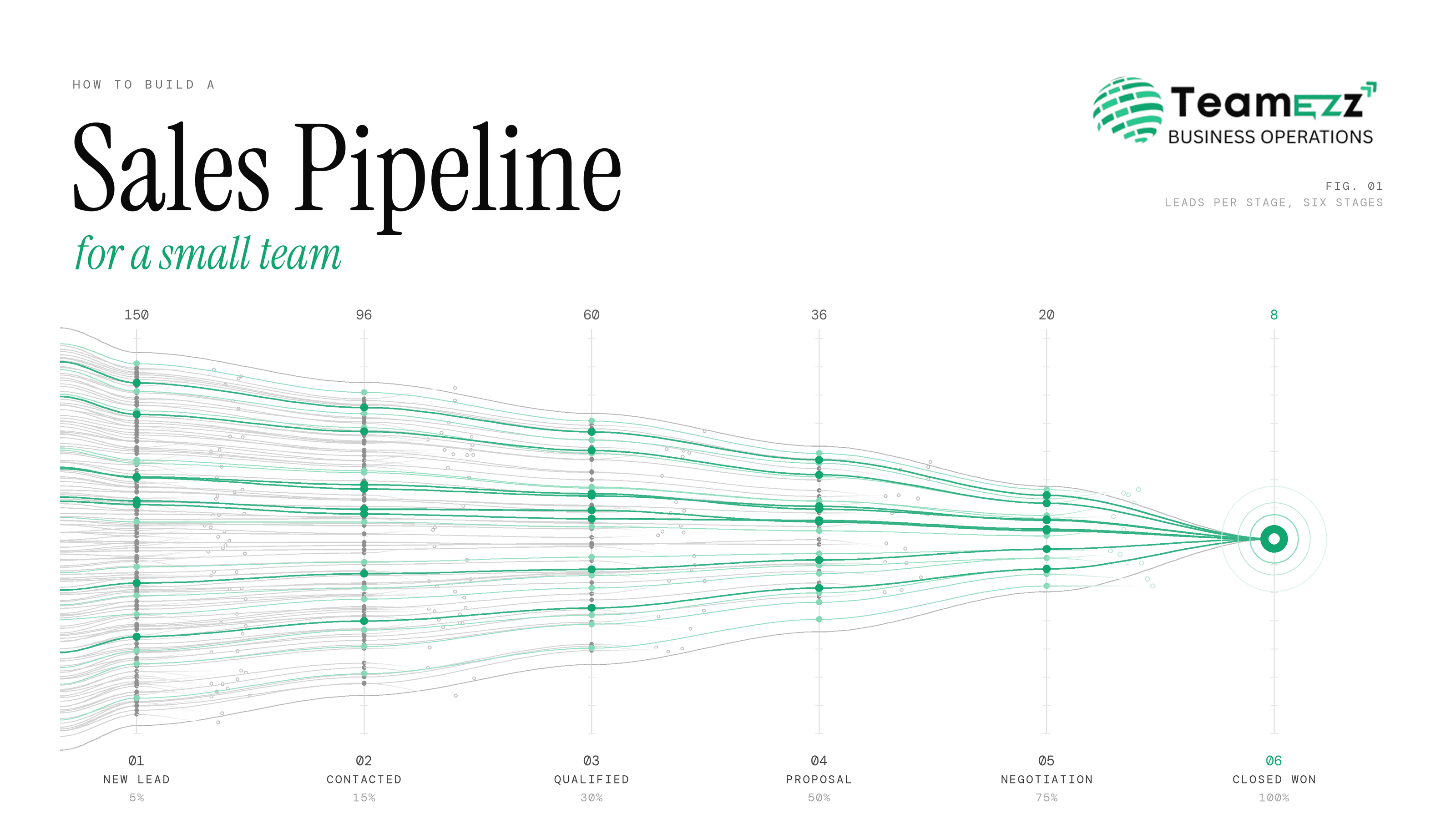
Small teams should keep stages few and simple. More than seven stages usually means people stop updating them. A solid starting
template:
Stage | What it means | Typical probability |
New Lead | Contact captured, not yet reached | 5% |
Contacted | Two-way conversation started | 15% |
Qualified | Confirmed need, budget and decision-maker | 30% |
Proposal Sent | Quote or proposal delivered | 50% |
Negotiation | Discussing price, scope or terms | 75% |
Closed Won | Deal signed or payment received | 100% |
Closed Lost | Deal rejected or went silent | 0% |
Adjust the names and percentages to match your own history. After a few months, replace these guesses with your actual win rates for each stage.
Step 3: Set Entry and Exit Criteria for Each Stage
This step is where most pipelines succeed or fail. A deal should move forward only when something specific happens, not because someone feels optimistic.
Examples of exit criteria:
- Contacted → Qualified: the prospect has confirmed their budget range and who approves the purchase.
- Qualified → Proposal Sent: you have a written scope and a price, and the prospect asked for it.
- Proposal Sent → Negotiation: the prospect has replied with questions or counter-terms.
- Negotiation → Closed Won: agreement is written (email counts) and advance payment is received, if that is your policy.
Write these rules in one shared page. When everyone uses the same definitions, your sales pipeline management reports become trustworthy.
Step 4: Qualify Leads Early
Small teams cannot chase everyone. A simple qualification filter protects your time. Use the BANT checklist:
- Budget: can they afford your price?
- Authority: are you talking to the decision-maker?
- Need: is the problem urgent enough to solve now?
- Timeline: do they plan to buy within 30-90 days?
A lead that fails two or more checks can go into a nurture list instead of your active pipeline. This keeps the pipeline short, honest and easy to review.
https://www.salesforce.com/blog/sales/what-is-bant-lead-generation/
Step 5: Assign Owners and Next Actions
Every transaction requires two things always: an owner and one next action with a date.
"Follow up" is not a next action. "Call Rahul on Thursday to confirm the proposal" is. Deals that lack a dated next action are the deals that die silently.
For teams of 2 to 10 people, a rule that fits perfectly is:
- The individual who makes the initial contact with the lead owns it until Closed Won or Closed Lost.
- All transactions that have been idle for more than seven days should be highlighted in the weekly review meeting.
- Handover will occur at the stage of Closed Won only.
Step 6: Choose a Tool That Matches Your Size
An enterprise software is not necessary at all. Choose it according to the number of transactions and the amount of time you wish to devote to data entry.
- Spreadsheets (Google Sheets/Excel): perfect for 30 deals or less. Affordable, but lacks reminders and automation.
- Visual board (Trello-like): drag-and-drop functionality works well with a small group.
- CRM with a pipeline view: ideal for use when you have repeat customers, a few employees, and multiple lead sources. Seek stage-wise Kanban view, reminder tasks, WhatsApp/email integration, and basic reporting.
In case you wish to have all of your pipeline, customer records, and follow-ups organized in a single platform suitable for Indian SMEs, cloud-based CRM like TeamEzz HRMS can be considered.
Whatever you decide to use, adoption is more important than features. Simplicity and regular usage are better than complexity and disuse.
https://www.teamezz.com/blog/simple-crm-software-for-small-businesses-what-you-need
Step 7: Review the Pipeline Every Week
A pipeline only helps when you look at it. Hold a 20-minute weekly review with this agenda:
- Stuck deals: anything that has stayed in one stage longer than your normal cycle.
- Closing this month: the deals in Proposal and Negotiation, and what is needed to close them.
- New lead flow: do you have enough top-of-pipeline deals to hit next month's target?
- Lost deals: why did we lose, and is there a pattern?
Key Metrics to Track
You do not need a dashboard with 30 numbers. Track these five:
Metric | How to calculate | Why it matters |
Pipeline value | Sum of all open deal values | Shows total opportunity |
Weighted pipeline | Deal value × stage probability | Gives a realistic forecast |
Conversion rate | Closed Won ÷ total leads | Shows overall efficiency |
Average sales cycle | Days from New Lead to Closed Won | Helps plan cash flow |
Average deal size | Total won revenue ÷ deals won | Guides which leads to prioritise |
A healthy rule of thumb: keep 3-4 times your monthly revenue target in open pipeline value. If your target is ₹5 lakh, aim for ₹15-20 lakh of qualified opportunities.
Common Pipeline Mistakes to Avoid
- Too many stages: the team stops updating them.
- No exit criteria: deals pile up in "Negotiation" without real progress.
- Never closing lost deals: dead deals inflate your forecast.
- Mixing leads and deals: a name from a business card is not a qualified opportunity yet.
- Updating only when the boss asks: update after every customer interaction, not weekly.
Conclusion
Building a sales pipeline for a small team is not about software. It is about clear stages, firm exit criteria, a named owner for every deal, and a weekly habit of reviewing. Start with the template above, run it for one month, and then refine the stages using your own data.
Ready to put your pipeline into practice? Pick your tool today, add your open deals, and book your first 20-minute weekly review.
FAQ
How many stages should a small team's sales pipeline have?
Five to seven stages is ideal. This is enough to show progress without making data entry a burden. Start simple and add a stage only when a real step in your process is missing.
What is the difference between a sales pipeline and a sales funnel?
Pipeline is a way to keep track of particular deals and their current status. Funnel is a structure showing the number of customers that are left in each phase. We apply pipeline on a day-to-day basis and funnel for analysis purposes.
Do I need a CRM for a sales pipeline for small business?
Not at the start. A spreadsheet works for a handful of deals. Move to a CRM when you struggle with missed follow-ups, multiple team members, or leads from many sources.
How often should I update my sales pipeline?
Update it immediately after every customer interaction, and hold a weekly review. Stale data is worse than no data because it creates false confidence in your forecast.
How do I know if my pipeline is healthy?
Check three signs: enough open pipeline value (about 3-4x your target), a steady flow of new leads each week, and few deals stuck beyond your average sales cycle.